The 8 documents every cleaning business owner needs (and why most operators wing it).
"When I started Deep Care Residential Cleaning, I made a list of every single document I'd need to actually run the business. That list ended up being longer than I expected."
When I started Deep Care Residential Cleaning, I made a list of every single document I'd need to actually run the business. Not the company-formation paperwork or the insurance certificates — those are obvious. I'm talking about the day-to-day documents that go between you and your clients, you and your cleaners, you and the work.
That list ended up being longer than I expected. And the painful part: most of those documents have to be branded, professional, and consistent if you want clients to take you seriously and cleaners to actually use them.
Here's what every cleaning business needs, why, and what happens if you skip each one.
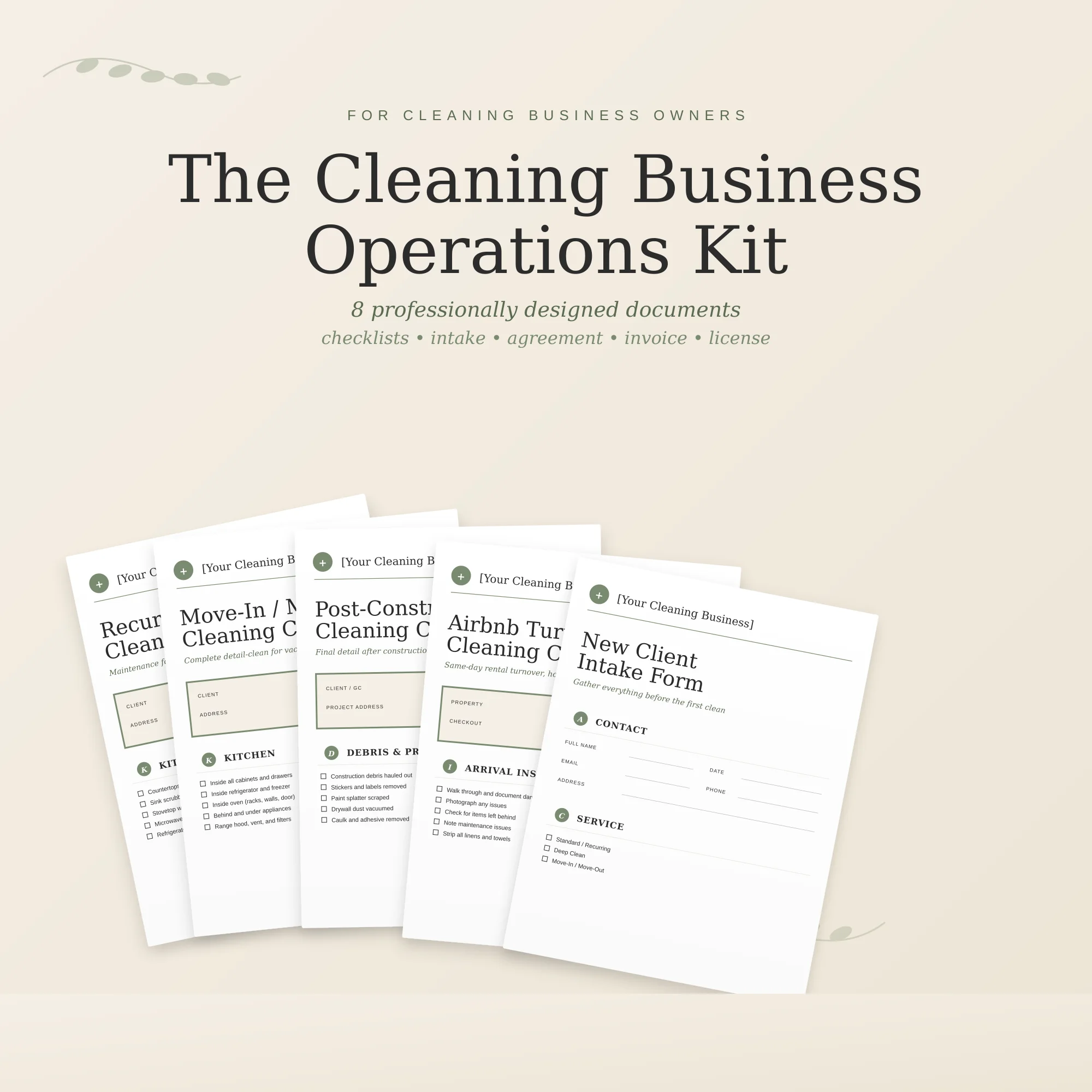
1. A Standard Cleaning Checklist
The baseline document your cleaners reference on every recurring visit. If you don't have one, you have inconsistency. One cleaner thinks "kitchen" means the counters; another thinks it includes inside the oven. Clients notice, complaints follow, and you spend your week explaining instead of cleaning.
A real checklist defines exactly what's included for the price quoted. It's also legal protection — when a client says "you didn't do X," you can point to the checklist and confirm whether X was on it.
2. A Move-In / Move-Out Checklist
Move-outs are different from recurring cleans. Empty properties get detail-cleaned: inside cabinets, behind appliances, inside ovens, window tracks, baseboards from top to bottom. If you charge move-out rates without a separate checklist, your cleaners default to recurring-clean mode, you take the loss, and the client's landlord still finds the dust strip on the fridge.
3. A Post-Construction Checklist
Different beast entirely. Dust everywhere, stickers on appliances, paint splatter on tile, drywall residue inside cabinets. You need a workflow that captures it all. Get this right and you can charge $0.40–$0.60/sq ft. Wing it and you'll undercharge by half.
4. An Airbnb / Short-Term Rental Turnover Checklist
The fastest-growing slice of residential cleaning revenue. Hosts review turnovers immediately, and one bad review on a $200/night listing costs them real money — they'll fire you over hair in the tub. A turnover checklist forces consistency on the 30+ small details that matter: hospitality-fold linens, toilet paper restock with extra rolls visible, hairdryer in place, thermostat set per instructions.
5. An Office / Commercial Cleaning Checklist
If you sell into offices, the recurring-checklist won't do — different surfaces, different priorities, restrooms get hammered. Commercial clients also expect a sign-off sheet showing the work was completed. A proper office checklist is that sheet.
6. A New Client Intake Form
The single document that pays for itself fastest. Without it, your discovery call is fishing — you forget to ask about pets, allergies, entry method, or product preferences, and you find out on job day. With it, every new client gets the same structured conversation, and you walk in already knowing the access code, the dog's name, and the fragrance-free product preference.
7. A Cleaning Service Agreement
The document most new operators skip and most experienced operators wish they hadn't. Covers payment terms, cancellation policy, property access, what happens when items get damaged, satisfaction guarantee, non-solicitation (so clients can't poach your cleaners). Without it, every dispute becomes a he-said-she-said. With it, the answer is in the document the client signed.
8. An Invoice Template
Sounds basic. But how an invoice looks signals whether you're a one-person side hustle or a real business. A clean, branded invoice with your logo, payment terms, and accepted methods turns "the cleaning lady's bill" into "professional service provider." Clients pay branded invoices faster than emailed numbers in the body of a text.
A note on the Service Agreement
The Service Agreement template in the kit covers all the standard sections (scope, payment, cancellation, property access, insurance, satisfaction guarantee, non-solicitation, photography, termination). It's a strong starting structure, but residential cleaning contracts have state-specific compliance requirements — cancellation rules, consumer protection statutes, lien laws — that vary by location. Before using it with real clients, get a 30-minute review from a licensed attorney in your state. Worth the $150–$300.
This post is part of an ongoing series on the operations side of running a residential cleaning business. Subscribe below if you want the next one (on pricing strategy) when it goes live.
Deep Care Residential Cleaning
Request A Quote or call 701-404-8357